Recently updated notes
-
 J. P. Donleavy1972May 5, 2026
We discovered the book in a second hand shop in Auckland, and slowly worked through it. A bizarre, surreal, sensual, thing of a book. A legit question somebody posed is "why do you waste your time rea…
-
 Alasdair Gray1992May 5, 2026
I discovered this book reading about the movie in some friends comments. I didn't like the movie too much (saw it on a plane, so maybe it's that) but the novel promises to be more working on the fact…
-
 Federico Campagna2025May 4, 2026
I just discovered this beok thanks to an episod of Lepht Hand (this one: https://splitinfinities.substack.com/p/lepht-hand-myth-nostalgia-and-liberation-598 ). I was already open to consider some its…
-
 Daniel Baumann2022May 4, 2026
When I was younger, say between middle- and high-school, I was always in awe with the cosmos. Questions about where "all this" came from, where it was going, and what kept everything together were exc…
-
 Joshua Agterberg2023no date
In situating our Cramer-Rao bound for dynamics parameters against existing static theory, Random Dot Product Graphs as Dynamical Systems: Limitations and Opportunities cites Agterberg et al. for two-to-infinity rates whose dependence on the spectral gap mirro…
-
 Minh Tang2022no date
We cite the asymptotic efficiency of the spectral estimator for stochastic blockmodel parameters in Random Dot Product Graphs as Dynamical Systems: Limitations and Opportunities to clarify that block-level inference is well behaved even though individual late…
-
 Minh Tang2018no date
The asymptotic normality of A's eigenvalues about those of P, with the O(1) Bernoulli-variance bias, is the result we lean on in Random Dot Product Graphs as Dynamical Systems: Limitations and Opportunities when arguing that bias matters relative to spectral-…
-
 Avanti Athreya2016no date
We rely on this limit theorem when summarising ASE consistency and the conditional Gaussian distribution of sqrt(n)(x_hat - Qx) in Random Dot Product Graphs as Dynamical Systems: Limitations and Opportunities, which provides the per-vertex fluctuation scale t…
-
 Fangzheng Xie2023no date
Xie and Xu's one-step procedure supplies the locally efficient per-vertex estimator we contrast with bare ASE in Random Dot Product Graphs as Dynamical Systems: Limitations and Opportunities, where matching the oracle MLE covariance up to orthogonal transform…
-
 Fangzheng Xie2020no date
To contrast our temporal Fisher information bound with static results, Random Dot Product Graphs as Dynamical Systems: Limitations and Opportunities cites Xie and Xu's Theta(d/n) minimax rate for latent position estimation under Frobenius loss, marking the pe…
-
 Barrett O'Neill1966no date
We apply O'Neill's submersion formula in Random Dot Product Graphs as Dynamical Systems: Limitations and Opportunities to express the sectional curvature of the base via the A-tensor, which lets us attribute all base curvature to vertical components of Lie br…
-
 Michel Journée2010no date
Journee, Bach, Absil, and Sepulchre developed low-rank optimization on the PSD cone using the same R*^{n x d}/O(d) quotient that Random Dot Product Graphs as Dynamical Systems: Limitations and Opportunities inherits, and we cite them alongside Absil and Massa…
-
 Miles Cranmer2023no date
After UDE training, Random Dot Product Graphs as Dynamical Systems: Limitations and Opportunities suggests Cranmer's SymbolicRegression.jl to extract closed-form expressions N(P)X from sampled state-velocity pairs, while warning that gauge dependence of the l…
-
 Mark I Freidlin1998no date
When comparing smoothing priors with dynamically consistent alternatives, Random Dot Product Graphs as Dynamical Systems: Limitations and Opportunities invokes Freidlin-Wentzell theory to show that the small-noise rate function for an SDE coincides with a dyn…
-
 Christopher Rackauckas2020no date
Once a trajectory has been recovered, Random Dot Product Graphs as Dynamical Systems: Limitations and Opportunities proposes fitting Universal Differential Equations from Rackauckas et al. so that the polynomial RDPG architecture supplies known mechanistic st…
-
 Markus Heinonen2018no date
In our comparison table of trajectory models, we list Heinonen et al.'s GP-ODE (NPODE) as an example that achieves both C^1 smoothness and dynamical consistency by learning the vector field as a Gauss…
-
 Joshua Daniel Loyal2025no date
Cited in Random Dot Product Graphs as Dynamical Systems: Limitations and Opportunities as an example of Bayesian hierarchical smoothing for RDPG trajectories that produces smooth interpolations but lacks dynamical consistency, since it does not enforce that v…
-
 Estelle Massart2020no date
Massart and Absil's quotient geometry with simple geodesics gives Random Dot Product Graphs as Dynamical Systems: Limitations and Opportunities the Procrustes distance as geodesic distance on the base manifold and the result that the injectivity radius at [X]…
-
 Estelle Massart2019no date
Massart, Hendrickx, and Absil compute sectional curvature on the fixed-rank PSD quotient, and Random Dot Product Graphs as Dynamical Systems: Limitations and Opportunities reuses their formulas to show that curvature on the base manifold blows up when the two…
-
 Shoshichi Kobayashi1963no date
Kobayashi and Nomizu's treatise supplies the classical principal-bundle machinery we invoke in Random Dot Product Graphs as Dynamical Systems: Limitations and Opportunities for existence and uniqueness of horizontal lifts and for the Ambrose-Singer theorem li…
-
 Timothée Poisot2015no date
We invoke this work in Random Dot Product Graphs as Dynamical Systems: Limitations and Opportunities to motivate temporal networks scientifically, citing ecological food webs that vary across space and time as a driver for asking how latent dynamics generate…
-
 Tanya Strydom2022no date
Cited in Random Dot Product Graphs as Dynamical Systems: Limitations and Opportunities as evidence that RDPG embeddings have been put to predictive use, specifically reconstructing trophic interactions, which strengthens the case that the latent representatio…
-
 Avanti Athreya2025no date
We discuss this work at length in Random Dot Product Graphs as Dynamical Systems: Limitations and Opportunities as the closest prior approach: their gauge-invariant Procrustes distance and Euclidean mirror summarize network evolution well for change-point det…
-
 Marcelo Fiori2024no date
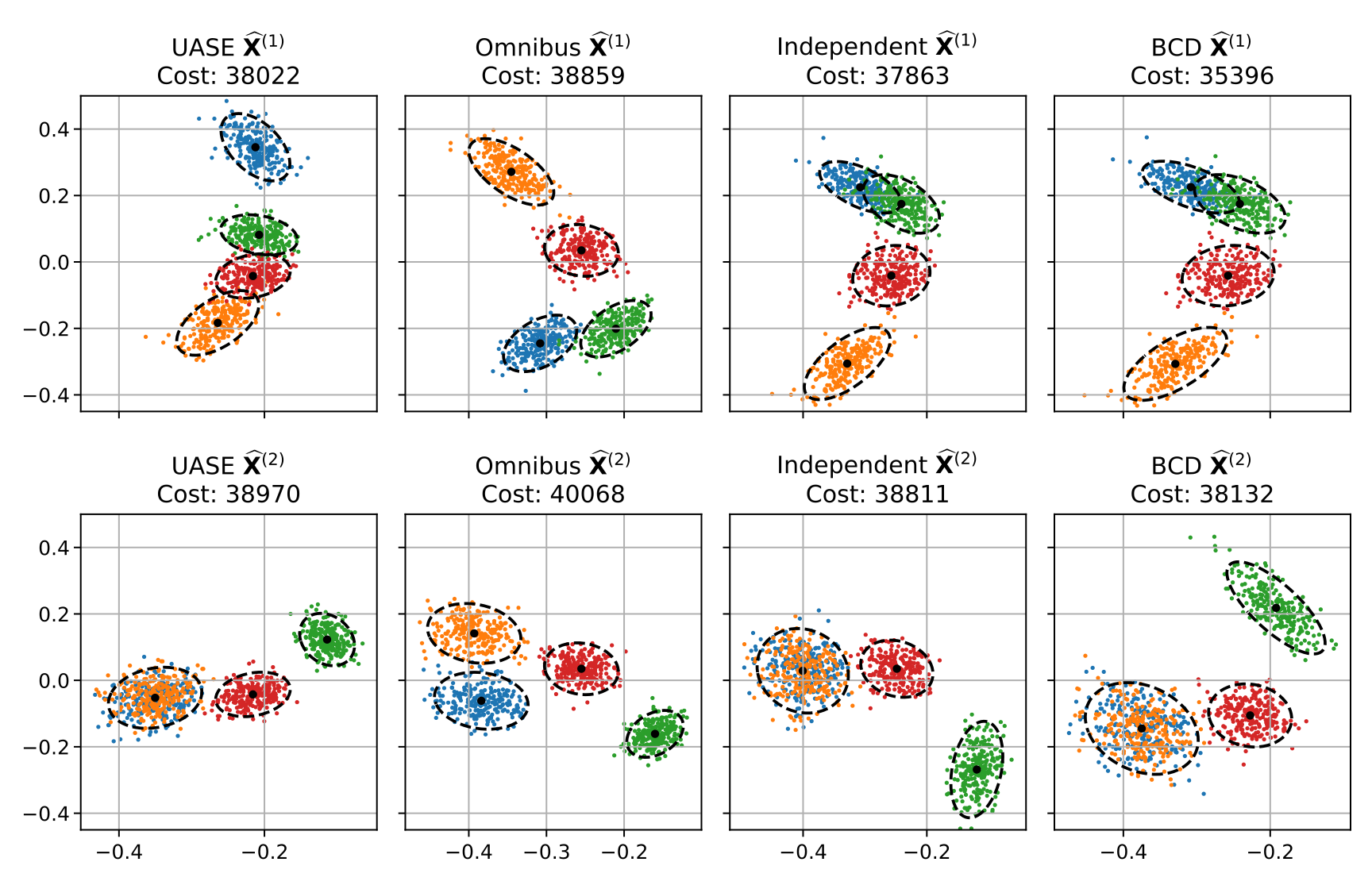
Fiori and coauthors study Riemannian optimization on matrices with orthogonal columns, which we read in Random Dot Product Graphs as Dynamical Systems: Limitations and Opportunities as a gauge-fixing section of our principal bundle; their tangent-space dimens…
-
 Andrea Filippo Beretta2025no date
We cite this work in Random Dot Product Graphs as Dynamical Systems: Limitations and Opportunities to draw the complementary contrast where geometry emerges from processes running on a network, whereas our setting has latent geometry generating the network an…
-
 Michael M Bronstein2021no date
Cited in Random Dot Product Graphs as Dynamical Systems: Limitations and Opportunities to flag gauge equivariance as a design principle in geometric deep learning, reinforcing that the differential-geometric vocabulary we deploy is shared across architectures…
-
 David M Rosen2019no date
Pose-graph optimization in SLAM is invoked in Random Dot Product Graphs as Dynamical Systems: Limitations and Opportunities as another setting that confronts analogous gauge freedom, supporting the claim that principal-bundle and holonomy ideas address phenom…
-
 Amit Singer2011no date
Cryo-EM reconstruction from projection images related by unknown rotations is cited in Random Dot Product Graphs as Dynamical Systems: Limitations and Opportunities as a parallel domain where time-varying latent states must be estimated up to a symmetry group…
-
 Giulio Valentino Dalla Riva2026no date
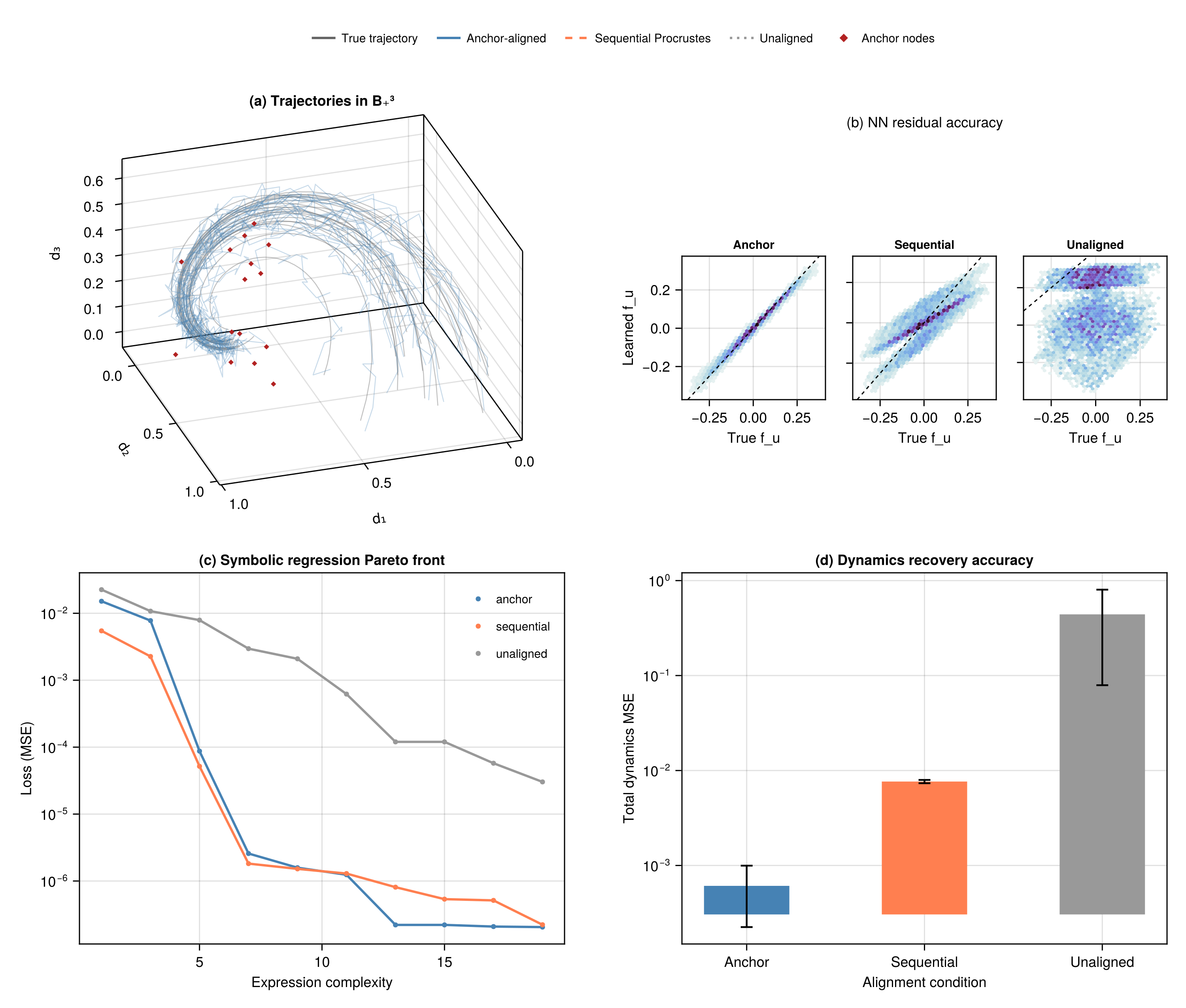
Learning dynamics from time-varying latent representations is a goal shared across many domains, from neural connectomics to social network analysis, yet it is fundamentally complicated by the non-ide…
-
 Richard C. Lewontin1970no date
We invoke Lewontin's three conditions (variation, differential reproduction, heredity) to anchor the definition of a Darwinian population, which Task ecologies and the evolution of world-tracking representations in large language models then applies at the level of whole tra…