Recently updated notes
-
 Jimmy Ba2022no date
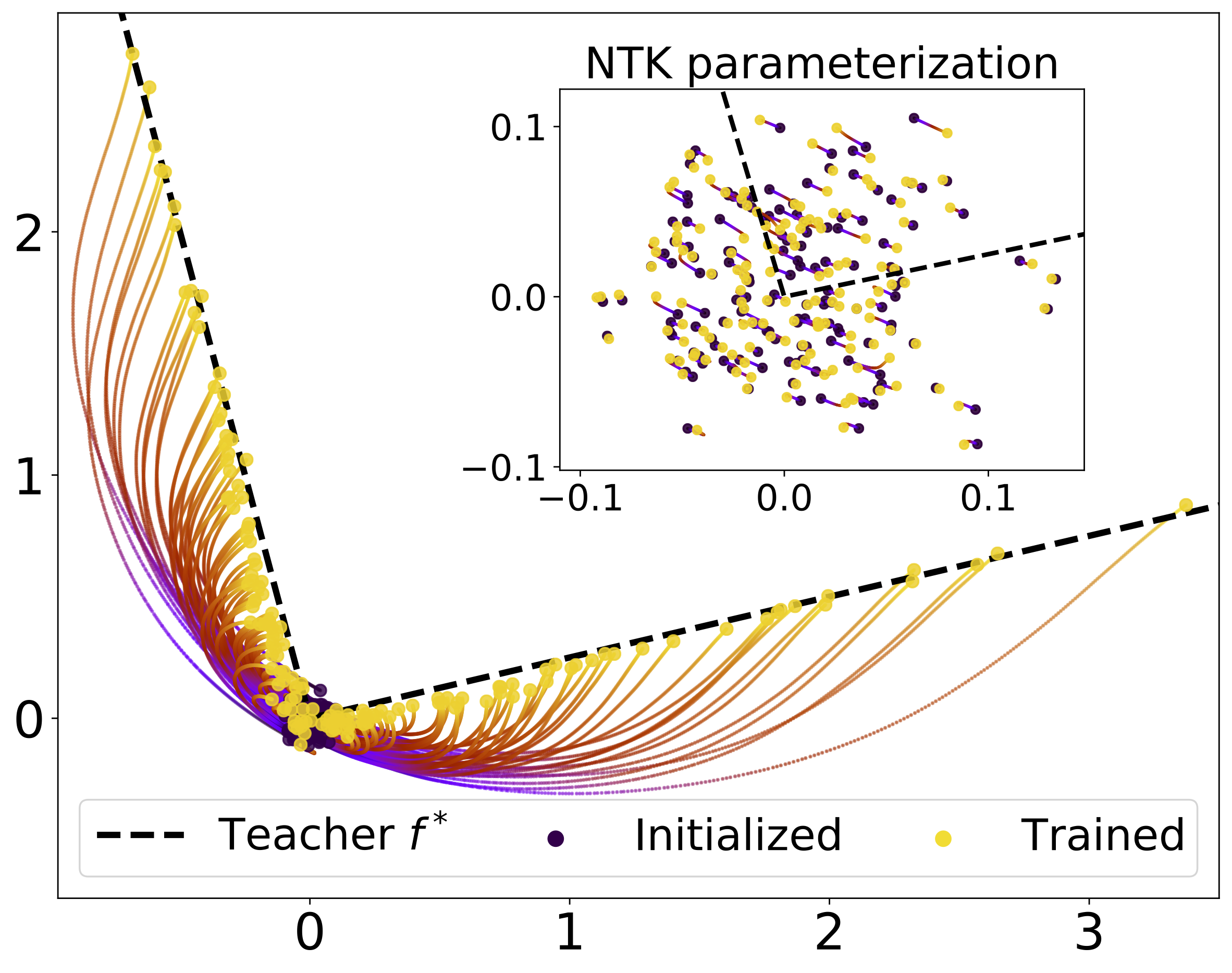
Their high-dimensional analysis of feature learning after one gradient step is cited in Task ecologies and the evolution of world-tracking representations in large language models as a possible ingredient for resolving the oracle-to-trained gap.
-
 Alexander Atanasov2022no date
The silent alignment result is grouped in Task ecologies and the evolution of world-tracking representations in large language models with other feature-learning analyses that could plausibly bridge optimization dynamics to the ecology-relative target.
-
 Jakob Uexüll2010no date
Between interface and truth: Multi-task selection drives ecologically veridical perception takes von Uexkull's Umwelt as a precursor to ecological veridicality, with the separation condition giving a mathematical formalisation of how species-specific perceptual worlds a…
-
 Elliott Sober2024no date
Sober's recent treatment of evolutionary theory reinforces the methodological view, paired with Sober (2008) in Between interface and truth: Multi-task selection drives ecologically veridical perception, that population-level laws need initial conditions and auxiliaries…
-
 Elliott Sober2008no date
Sober's analysis of evidence in evolution frames evidential support as model-comparative. We adopt this stance in Between interface and truth: Multi-task selection drives ecologically veridical perception to read our optimality and convergence theorems as conditional ad…
-
 Eugene Seneta2006no date
Seneta's treatise supplies the Perron-Frobenius machinery used in Between interface and truth: Multi-task selection drives ecologically veridical perception for reducible nonnegative matrices: the Frobenius block-triangular decomposition, the per-block Perron expansion…
-
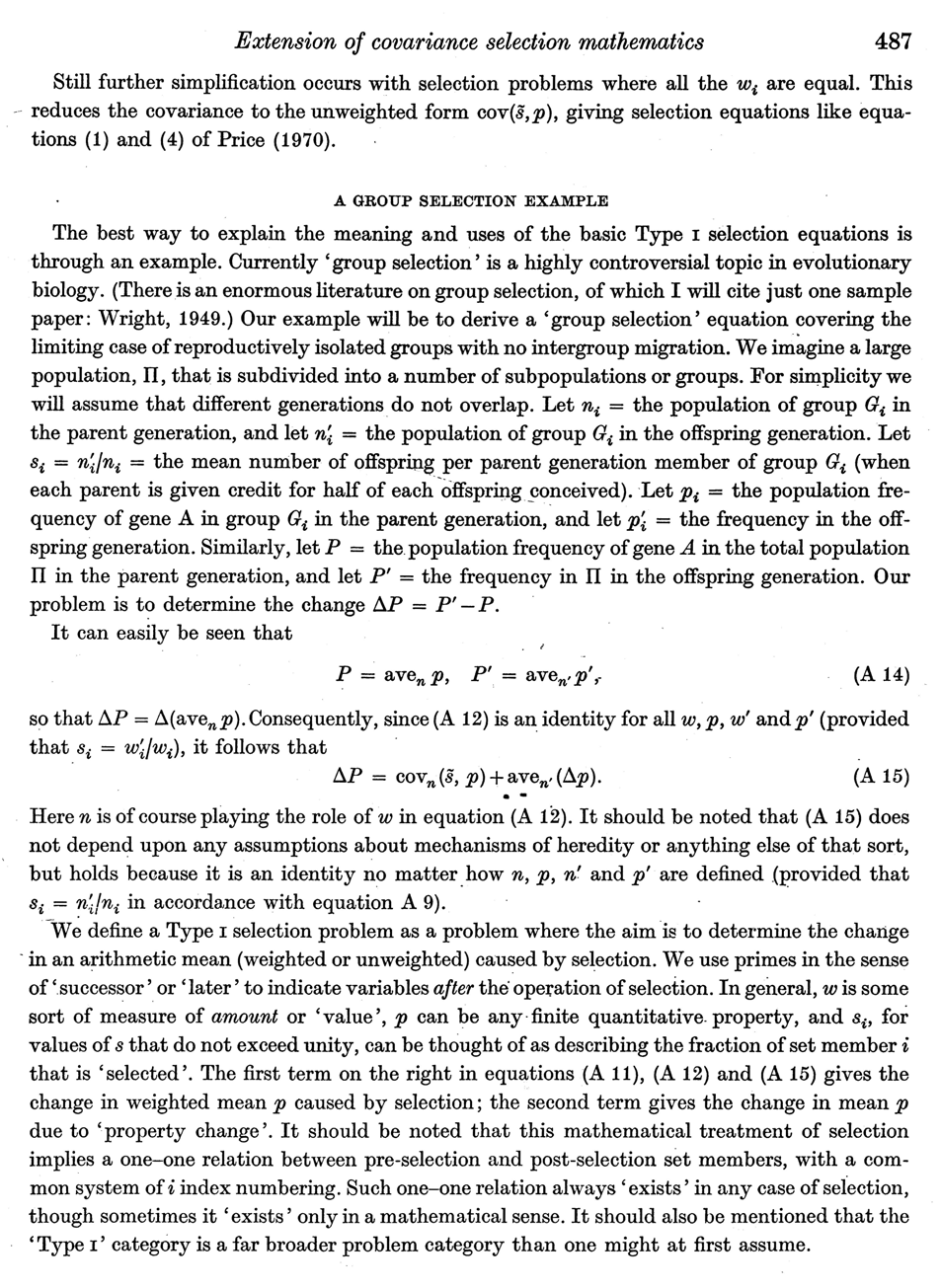 George R. Price1972no date
We pair Price's 1972 extension with his 1970 paper throughout the Price-equation derivation in Between interface and truth: Multi-task selection drives ecologically veridical perception, using it as the standard reference for the covariance-plus-transmission identity th…
-
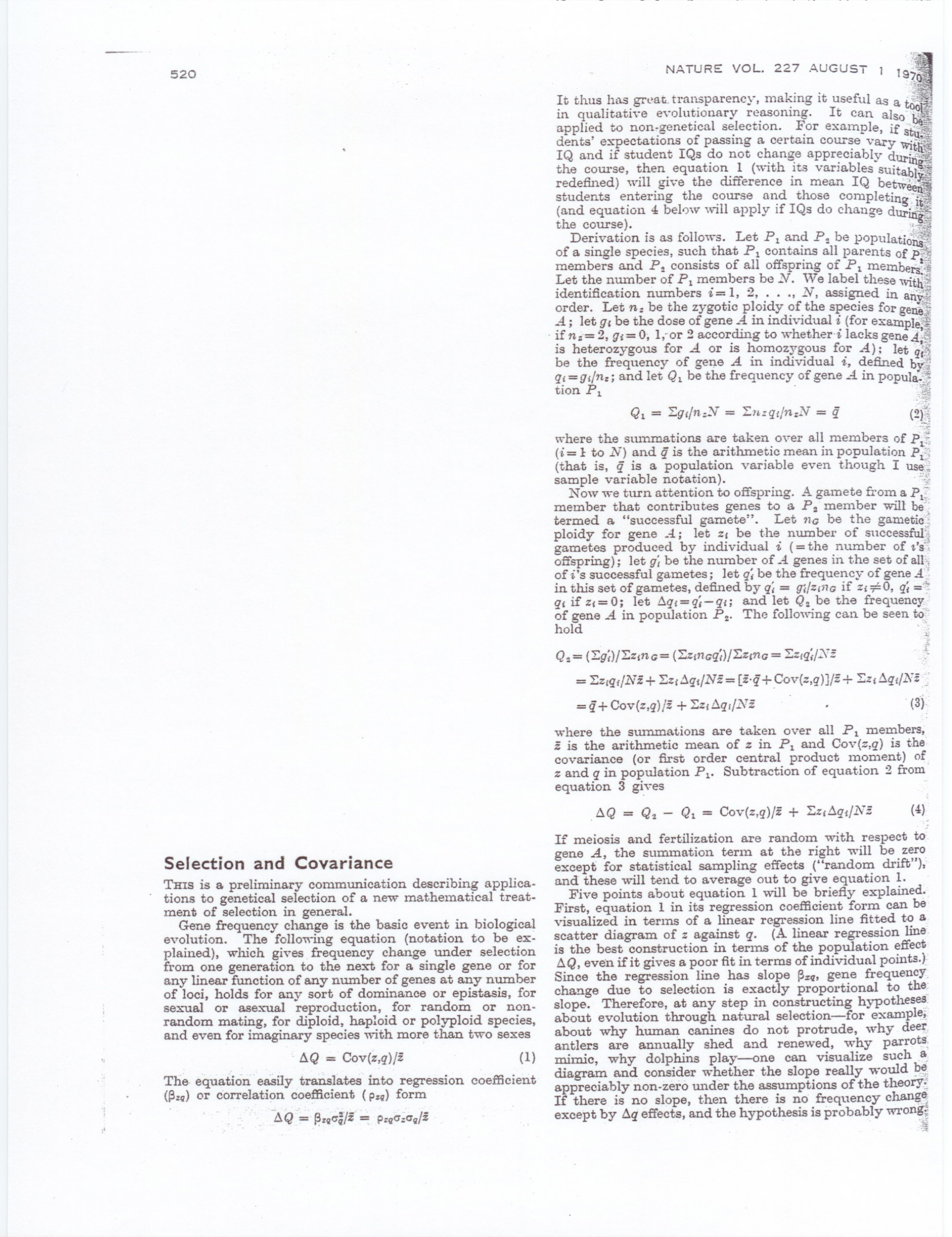 George R. Price1970no date
Price's 1970 covariance identity is the starting point for the one-generation decomposition we apply in Between interface and truth: Multi-task selection drives ecologically veridical perception, partitioning change in any encoding trait into a selection covariance with…
-
 Zenon W. Pylyshyn1999no date
Pylyshyn's cognitive impenetrability supplies the structural premise of Between interface and truth: Multi-task selection drives ecologically veridical perception: the encoding is fixed across tasks while only downstream readouts vary, which is what makes multi-task per…
-
 Chetan Prakash2020no date
Prakash and colleagues proved that single-task payoff functions generically fail to preserve total orders, group structures, and measurable spaces. Between interface and truth: Multi-task selection drives ecologically veridical perception uses this no-preservation resul…
-
 Massimo Pigliucci2006no date
Pigliucci and Kaplan argue that adaptationist explanations must be assessed against alternative causal pathways and developmental structure. We invoke this stance in Between interface and truth: Multi-task selection drives ecologically veridical perception to keep our t…
-
 Jeong-Man Park2010no date
We cite Park, Munoz, and Deem in Between interface and truth: Multi-task selection drives ecologically veridical perception both to situate our frequency-independent recursion within quasispecies theory and to acknowledge that real populations are finite and stochastic,…
-
 Andreas Maurer2016no date
Maurer, Pontil, and Romera-Paredes derived finite-sample excess-risk bounds for multi-task representation learning. We carry their shared-representation insight into Between interface and truth: Multi-task selection drives ecologically veridical perception and recast it…
-
 Wassily Hoeffding1963no date
We use Hoeffding's inequality in Between interface and truth: Multi-task selection drives ecologically veridical perception to bound the deviation of empirical from population Bayes risk, yielding, together with a union bound over encodings, a polynomial-in-N sample com…
-
 Donald D. Hoffman2019no date
Hoffman's book draws the philosophical conclusion that perception shows icons on a desktop rather than reality. We engage this position in Between interface and truth: Multi-task selection drives ecologically veridical perception as the strong non-veridical reading our…
-
 Anne Greenbaum2020no date
We rely in Between interface and truth: Multi-task selection drives ecologically veridical perception on Greenbaum, Li, and Overton for two ingredients: the first-order analytic perturbation of the simple Perron eigenpair around the diagonal fitness matrix, and the Baue…
-
 Peter Godfrey-Smith2024no date
Cited alongside Godfrey-Smith (2009) in Between interface and truth: Multi-task selection drives ecologically veridical perception to support the model-based stance on Darwinian populations, which justifies treating our framework as an idealised map rather than a full b…
-
 Peter Godfrey-Smith2009no date
Following Godfrey-Smith's model-based treatment of Darwinian populations, we frame the apparatus of Between interface and truth: Multi-task selection drives ecologically veridical perception as an idealised map from ecological structure to selective pressure, with no cl…
-
 Steven A. Frank2025no date
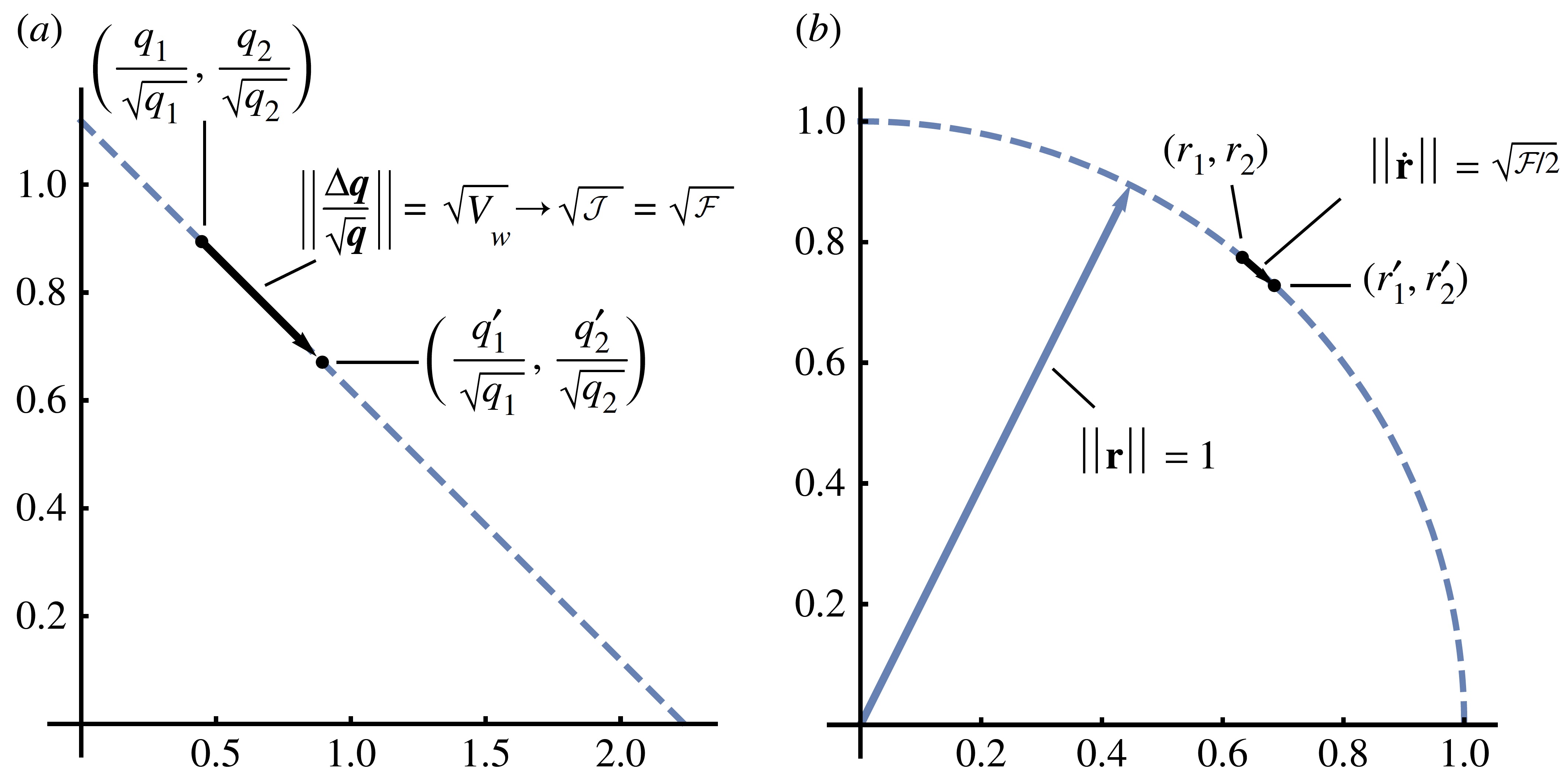
Frank's force-metric-bias decomposition of the Price equation provides the conceptual bridge sketched in Between interface and truth: Multi-task selection drives ecologically veridical perception between evolutionary dynamics and algorithmic learning, with our Appendix…
-
 Stewart N. Ethier1986no date
We invoke in Between interface and truth: Multi-task selection drives ecologically veridical perception the density-dependent population-process limit from Chapter 11 of Ethier and Kurtz to show Wright-Fisher trajectories converge in probability to the deterministic rep…
-
 Manfred Eigen1971no date
We frame our deterministic recursion in Between interface and truth: Multi-task selection drives ecologically veridical perception as the frequency-independent quasispecies setting introduced by Eigen, where expected fitness depends on the encoding alone and the replica…
-
 Marlene D. Berke2022no date
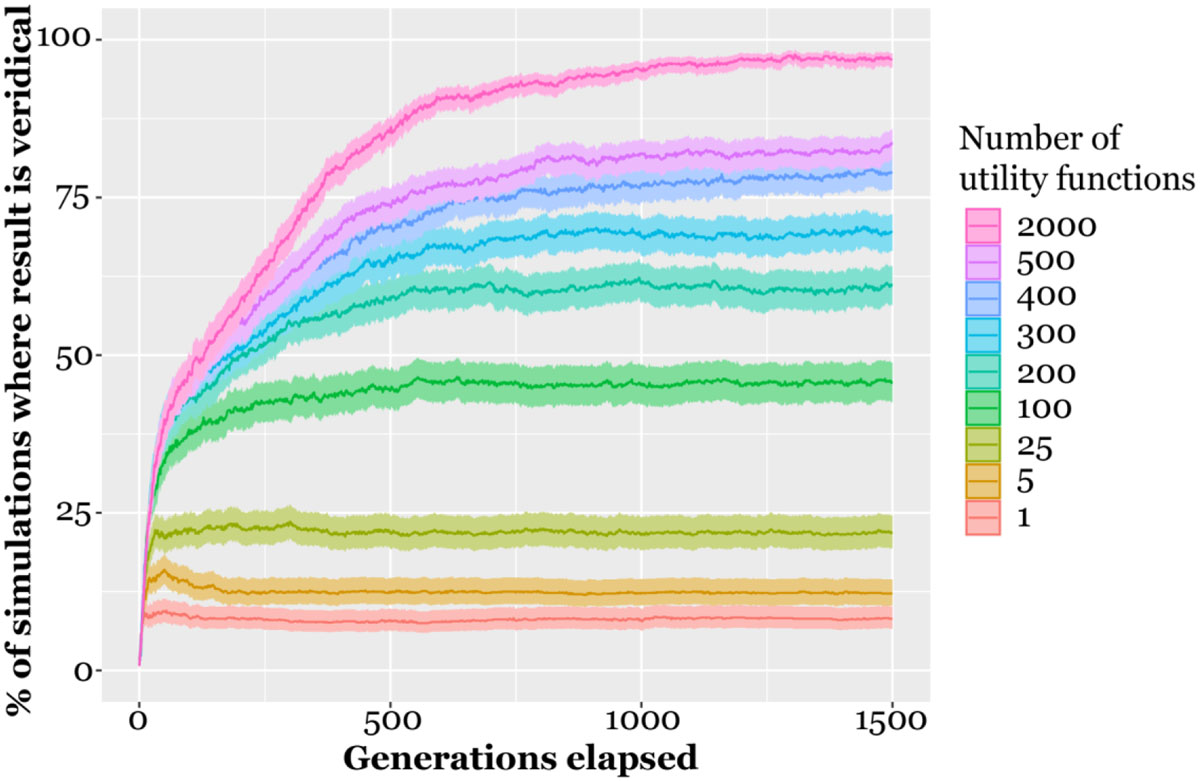
Berke and colleagues showed by simulation that cognitively impenetrable encodings facing many tasks favour veridical perception, and called for mathematical models. We answer that call in Between interface and truth: Multi-task selection drives ecologically veridical perception…
-
 Jonathan Baxter2000no date
We adapt in Between interface and truth: Multi-task selection drives ecologically veridical perception Baxter's analysis of inductive bias learning, where shared representations across related tasks improve sample complexity, porting that statistical-learning insight in…
-
 Jacob Andreas2022no date
Andreas's argument that language models can be read as agent models is cited in Task ecologies and the evolution of world-tracking representations in large language models as part of the recent debate over whether ML systems represent their targets in any substantive sense.
-
 Dimitri Coelho Mollo2025no date
Paired with Sullivan on the vector grounding problem; Task ecologies and the evolution of world-tracking representations in large language models reframes that grounding worry as a question about which world-state distinctions a sufficient encoding must preserve.
-
 Naftali Tishby1999no date
We position Task ecologies and the evolution of world-tracking representations in large language models as a specialization of the information bottleneck's compress-while-preserving-prediction tradeoff to the autoregressive ecology-relative setting.
-
 Kevin Laland2016no date
Task ecologies and the evolution of world-tracking representations in large language models invokes Laland and colleagues to frame model-generated text re-entering training corpora as a niche-construction problem, where future ecologies are reshaped by the very models adapti…
-
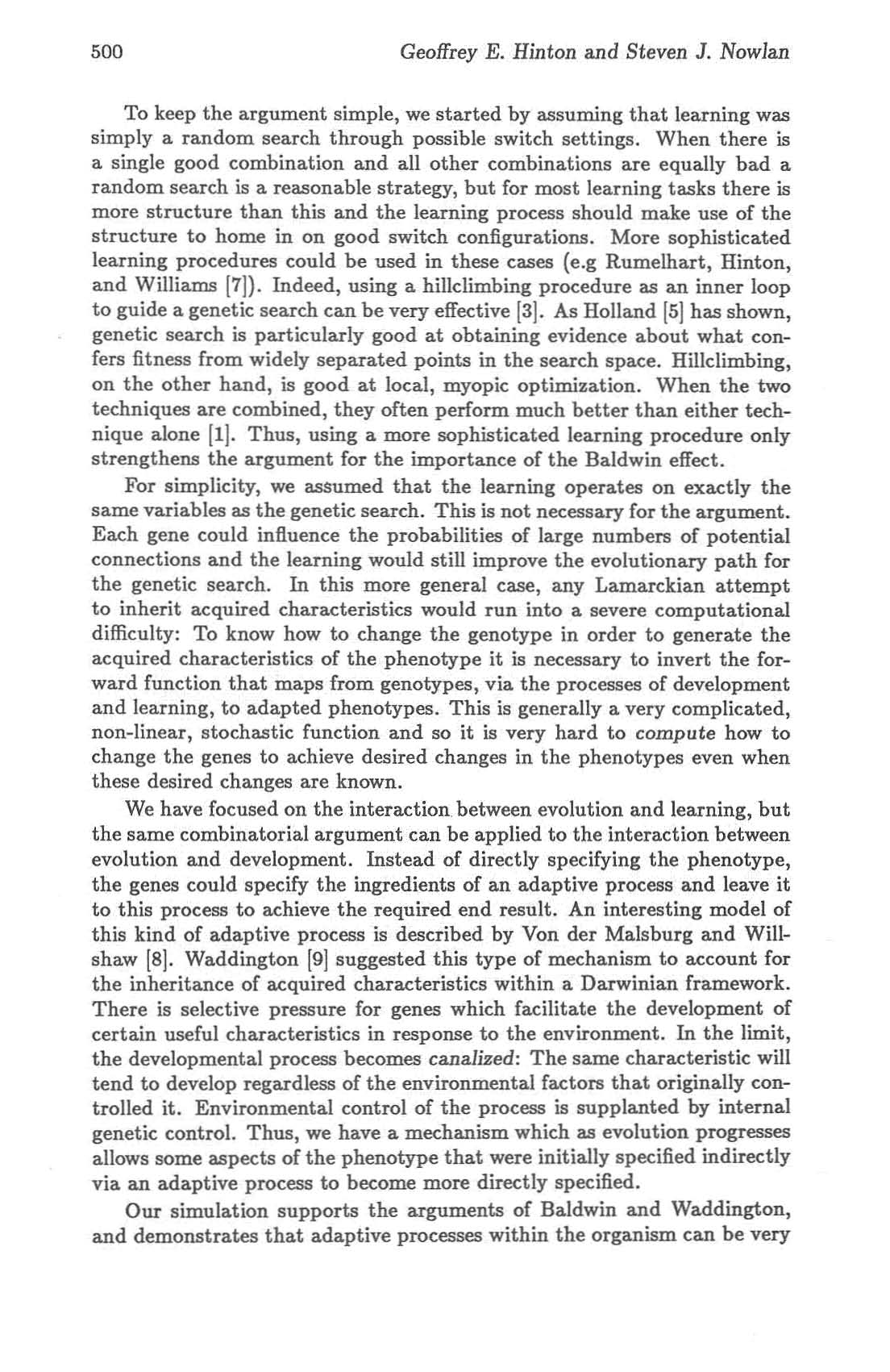 Geoffrey E. Hinton1987no date
Hinton and Nowlan are cited alongside Baldwin in Between interface and truth: Multi-task selection drives ecologically veridical perception to delimit how lifetime learning interacts with our static optimality results: learned encodings shape evolutionary trajectories o…
-
 James Mark Baldwin1896no date
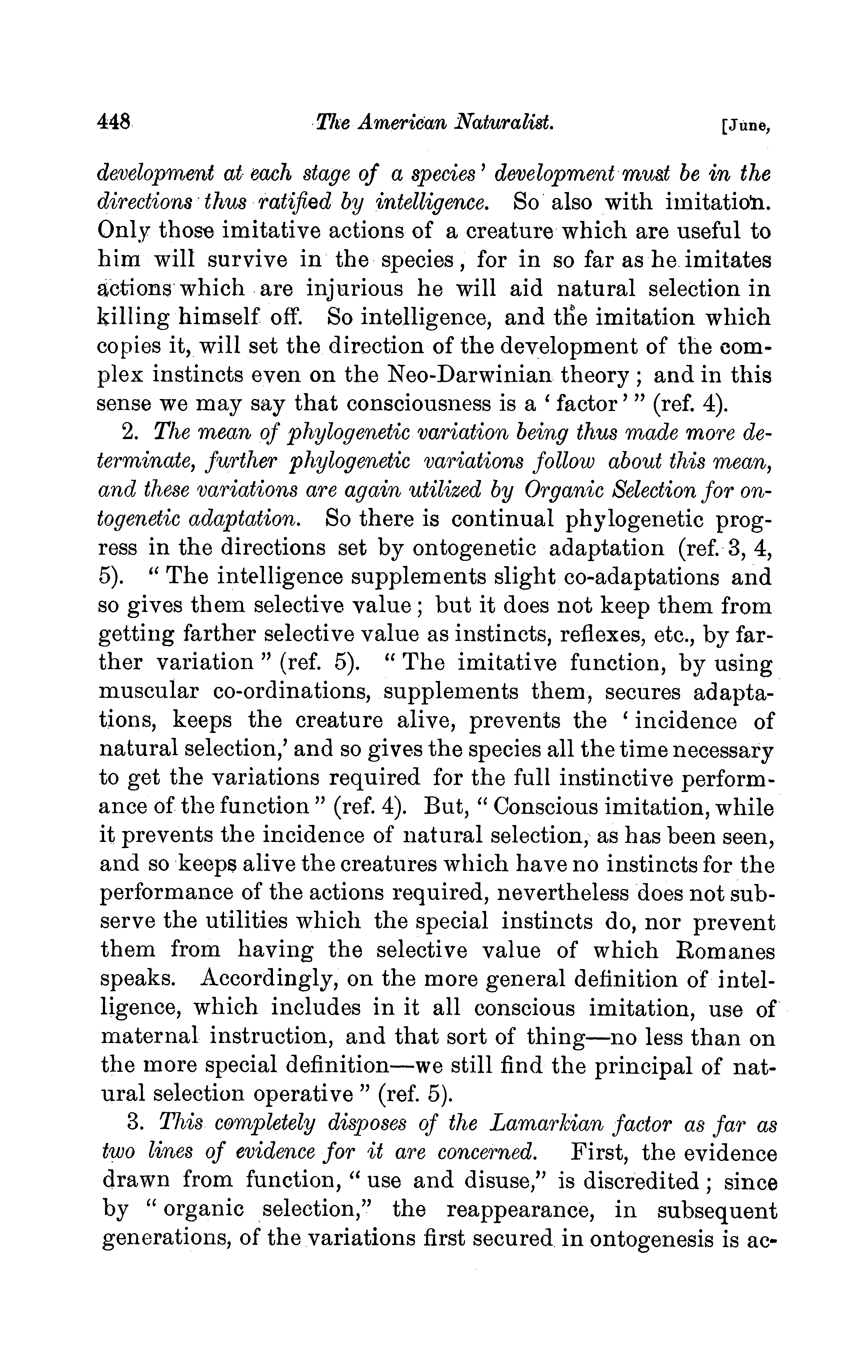
We invoke the Baldwin effect in Between interface and truth: Multi-task selection drives ecologically veridical perception to clarify the scope of within-lifetime learning: developmental optimisation of an encoding does not replace evolutionary convergence, it can accel…
-
 Barton L. Anderson2015no date
Anderson identified the logical gap in interface theory by arguing that organisms must adjust behaviour across multiple homeostatic demands within ontogenetic time. We take his philosophical critique…