Recently updated notes
-
 Jesús Arroyo2021no date
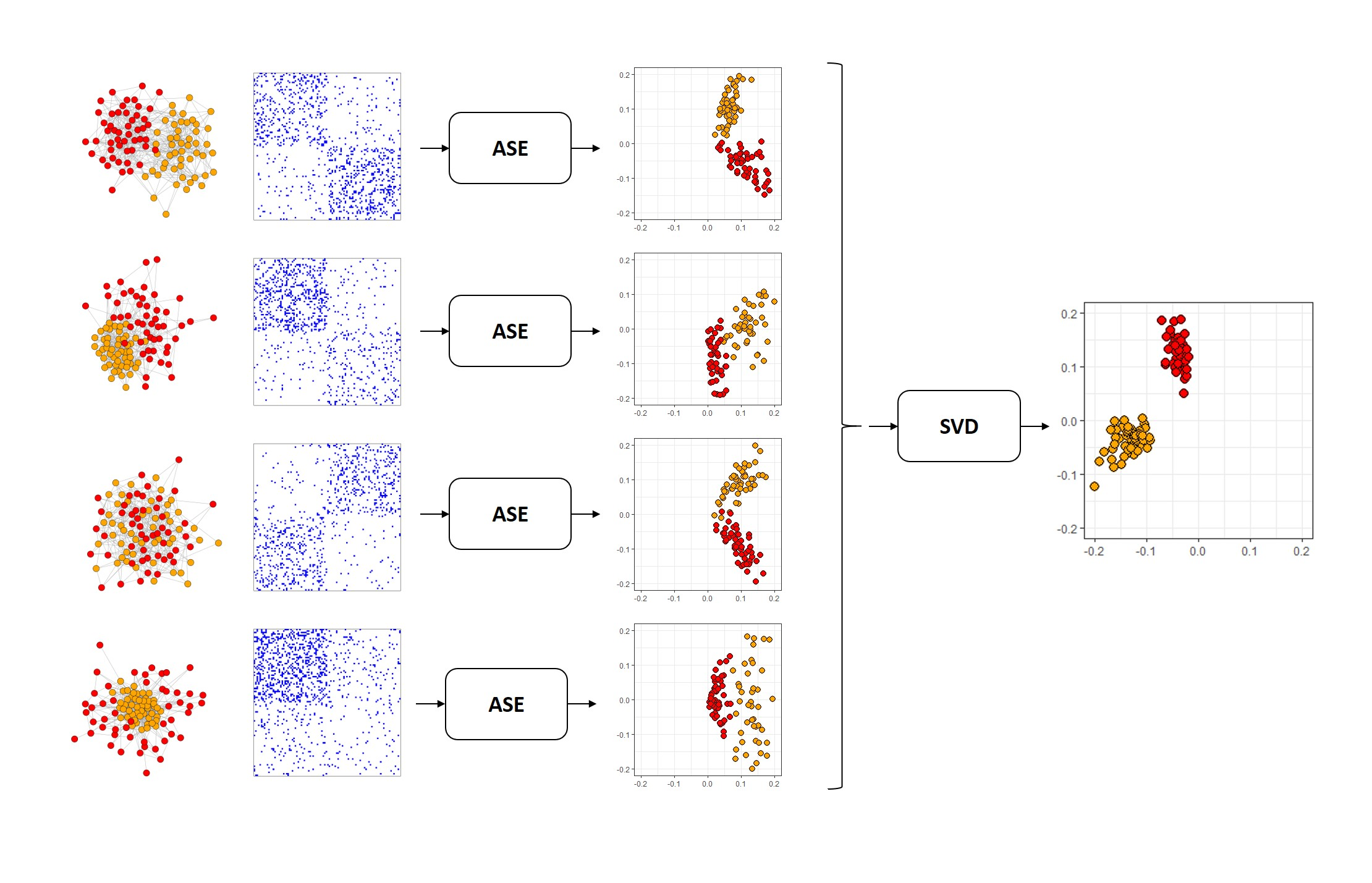
We group COSIE with Omnibus and UASE as joint embedding methods that presuppose a shared invariant subspace across time slices; in Random Dot Product Graphs as Dynamical Systems: Limitations and Opportunities we argue that ODE-driven latent positions generall…
-
 Jeff Cheeger1970no date
Referenced in Intensity Dot Product Graphs as the origin of the Cheeger inequality linking spectral gap to isoperimetric constants, motivating possible interpretations of the symmetric continuous Laplacian.
-
 Ronald R. Coifman2006no date
Cited in Intensity Dot Product Graphs to draw a parallel between the heat map and diffusion-map embeddings, suggesting their bound heat operator could yield embeddings of the latent domain where distances re…
-
 Nicolás García Trillos2020no date
Cited in Intensity Dot Product Graphs alongside Hein et al. for quantitative spectral convergence rates of graph Laplacians toward the Laplace-Beltrami operator, signaling the kind of error estimates a direc…
-
 Matthias Hein2007no date
Cited in Intensity Dot Product Graphs as prior work on convergence of discrete graph Laplacians to continuous operators on random neighborhood graphs, flagged as the closest analogue for a future IDPG Laplac…
-
 Ulrike Luxburg2007no date
Cited in Intensity Dot Product Graphs to motivate asking whether singular functions of the bound heat operator reveal latent community structure in the intensity landscape, by analogy with how Laplacian eige…
-
 François Caron2017no date
Cited as the originating work on sparse exchangeable random-measure graphs, an alternative route to random vertex populations that Intensity Dot Product Graphs contrasts with its own Euclidean, dot-product l…
-
 Victor Veitch2015no date
Cited alongside Caron and Fox for the graphex class of sparse exchangeable graphs from random measures, which Intensity Dot Product Graphs flags as lacking the explicit finite-dimensional latent geometry tha…
-
 Christian Borgs2019no date
Cited in Intensity Dot Product Graphs as the L^p extension of graphon theory that handles sparse graphs, contextualizing IDPG's own dense-to-sparse interpolation as an alternative route through Poisson lifet…
-
 Christian Borgs2008no date
Paired with Lovasz to ground the digraphon and graph-limit framework that Intensity Dot Product Graphs compares with, particularly the cut-metric machinery underlying the regularity-obstruction theorems for…
-
 Hermann Weyl1912no date
Cited in Intensity Dot Product Graphs for Weyl's inequality on singular value perturbations, used both to bound spectral differences between operators and to control Bernoulli noise in the adjacency-to-desir…
-
 James Mercer1909no date
Cited in Intensity Dot Product Graphs to mark the symmetric positive-definite specialization of the spectral expansion, where the SVD of the bound heat operator collapses to Mercer's eigendecomposition.
-
 Erhard Schmidt1907no date
Invoked in Intensity Dot Product Graphs as the original source of the Schmidt decomposition theorem, justifying the singular value expansion of the asymmetric bound heat kernel into orthonormal left and righ…
-
 Timothée Poisot2016no date
Cited in Intensity Dot Product Graphs to acknowledge prior recognition that food webs should be treated as probabilistic objects, supporting the framing of classic food webs as statistical summaries of an un…
-
 Giulio V. Dalla Riva2016no date
Recognized in Random Dot Product Graphs as Dynamical Systems: Limitations and Opportunities as the first application of RDPG to ecological networks, showing that latent positions capture evolutionary signatures in food webs and grounding the ecological motiva…
-
 Avanti Athreya2018no date
We anchor Random Dot Product Graphs as Dynamical Systems: Limitations and Opportunities in the RDPG framework via this survey, which catalogs the spectral estimation theory and applications to connectome analysis and social network inference that we build on.…
-
 Mu Zhu2006no date
Cited in Intensity Dot Product Graphs alongside other singular-value thresholding methods as one approach to selecting an embedding dimension from the singular value sequence of the adjacency matrix during I…
-
 Matan Gavish2014no date
Listed in Intensity Dot Product Graphs as an example of optimal singular value truncation for choosing the latent dimension during the spectral embedding step of IDPG inference.
-
 Sourav Chatterjee2015no date
Referenced in Intensity Dot Product Graphs as a matrix estimation technique for selecting an appropriate dimension from the singular values of the adjacency matrix when fitting an IDPG.
-
 Patrick Rubin-Delanchy2022no date
We invoke the generalised RDPG interpretation alongside the Sankhya limit theorem in Random Dot Product Graphs as Dynamical Systems: Limitations and Opportunities to record that per-vertex covariances depend on the edge variance profile, a fact our Fisher inf…
-
 Stephen J Young2007no date
Cited alongside the Athreya survey to mark the original RDPG model, providing the foundational definition that Random Dot Product Graphs as Dynamical Systems: Limitations and Opportunities extends to the dynamical setting where latent positions evolve in time…
-
 Edoardo M Airoldi2008no date
Listed among the established families that fix the node set and randomize edges, with mixed-membership stochastic blockmodels standing in for the broader SBM literature. Intensity Dot Product Graphs groups i…
-
 Diana Cai2016no date
Cited in Intensity Dot Product Graphs for the directed analogue of exchangeable-graph priors, providing the digraphon-specific weak-isomorphism machinery that Theorem 5 (no regular equivalent digraphon) reli…
-
 Peter Orbanz2014no date
Cited in Intensity Dot Product Graphs as the foundational reference for exchangeable arrays and graphon priors, grounding the weak-isomorphism representation theorem that lifts the regularity obstruction fro…